
Causal Attribution: See What Truly Drives Revenue
Measure the real impact of every channel and keep spend on track against your plan
Causal Attribution shows you which channels, campaigns, and ad sets are actually growing your business, so you can shift budget toward what works and pull back from what doesn't.
In Lifesight, it brings incremental measurement and your active media plan into one place, so you always know both what is driving outcomes and whether your spend is on track.
Unlike touch-based attribution, which hands out credit based on clicks and views, Causal Attribution is built on evidence. Incremental results come from your promoted Marketing Mix Models and experiment results, giving you a view of performance you can confidently act on.
Make evidence-backed budget decisions
With Causal Attribution, you can:
- Separate real impact from reported credit by comparing platform-reported revenue with incremental revenue. For example, a channel reporting $1M in revenue may be driving only a fraction of that as truly incremental revenue.
- Understand true efficiency at a glance with total spend, iROAS, incrementality factor (the share of platform-reported revenue that is truly incremental), and net spend versus plan.
- Catch overspend and underspend early by monitoring pacing against your active scenario.
- Find exactly where performance is won or lost by analyzing results from channel down to tactic (the strategy or ad type within a channel, such as prospecting or retargeting), campaign, and ad set.
- Know where to invest next with clear Scale, Maintain, and Reduce recommendations.
- Turn insight into action by deploying a recommendation straight into the Decisions workflow.
See performance and pacing in one view
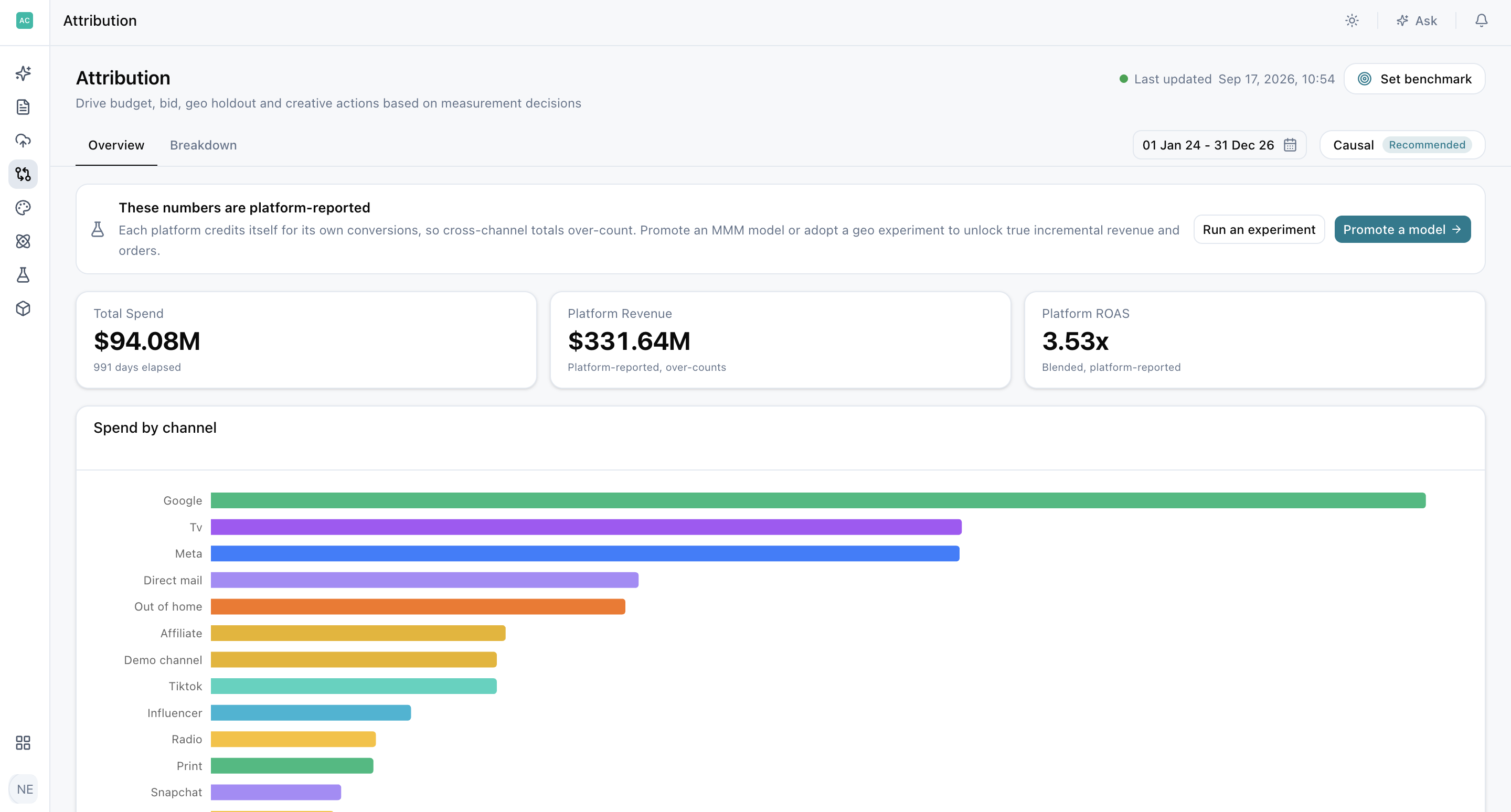
The Overview gives you a snapshot of how your marketing is performing for the selected date range, so you can quickly spot what needs attention.
What you'll find
- Headline metrics: your top-level view of spend and incremental performance.
- Pacing against plan: how your spend is tracking compared with your active scenario.
- Platform-reported versus incremental revenue: a side-by-side comparison that shows how much of each channel's reported revenue is real growth.
How channels are ranked
Channels are ranked by incremental value, so the ones contributing the most real growth rise to the top. Channels that look better on paper than in practice, with high platform-reported revenue but low incremental revenue, are easy to identify.
Pinpoint what's working at every level
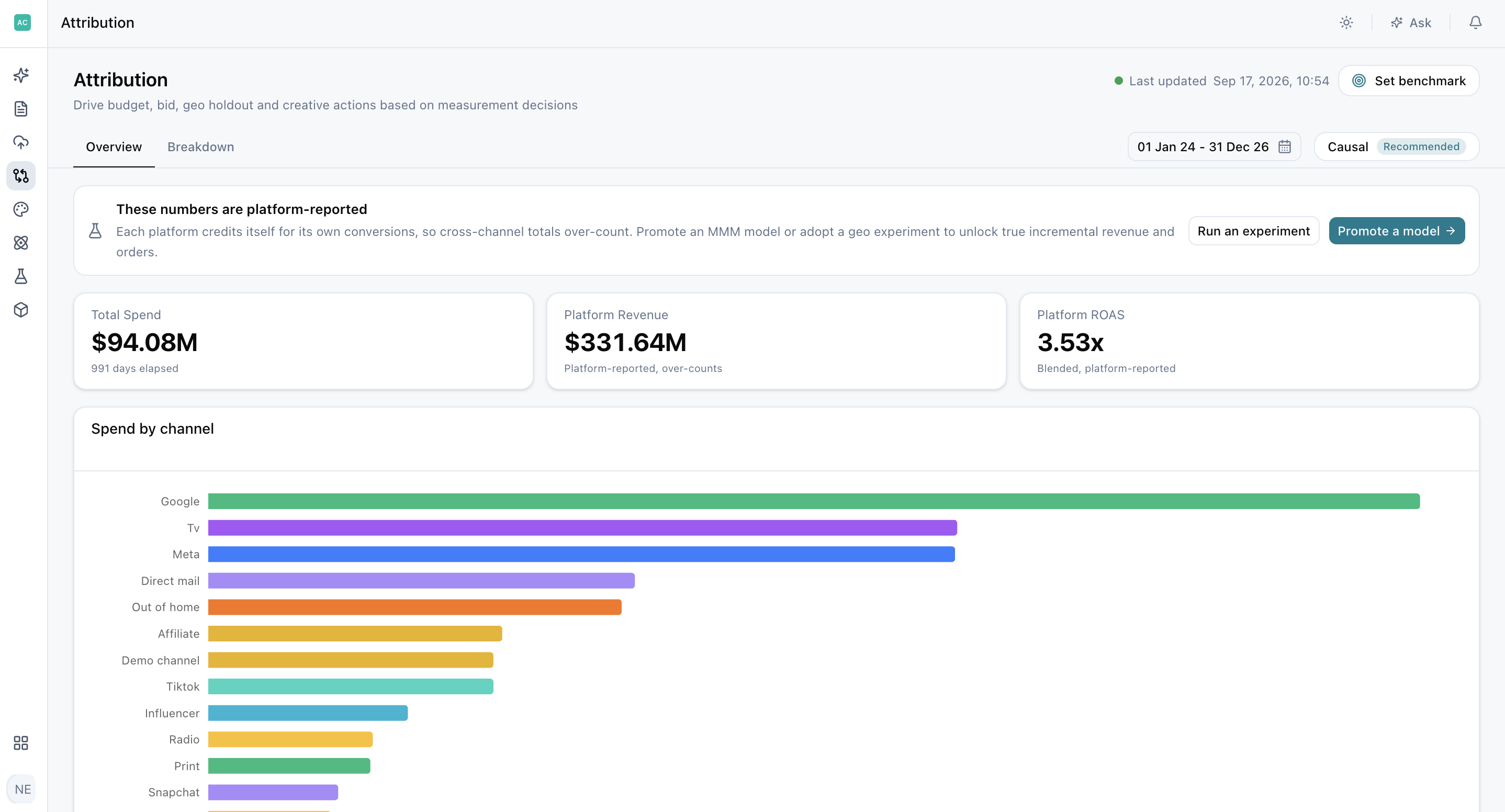
The Breakdown lets you go beyond channel totals to find the specific tactics, campaigns, and ad sets driving incremental results.
What you can do
- Search for any channel, tactic, campaign, or ad set.
- Choose the columns that matter most to your analysis.
- Sort by any metric to surface your top and bottom performers.
- Select rows to drill deeper into the entities behind a result.
- Open weekly spend details to see how investment has changed over time.
This makes it easier to explain why a channel is performing the way it is and to decide exactly where to adjust. For example, if a channel's iROAS has dropped, you can drill down to find the specific campaign responsible rather than cutting the whole channel.
Keep spend aligned with your plan
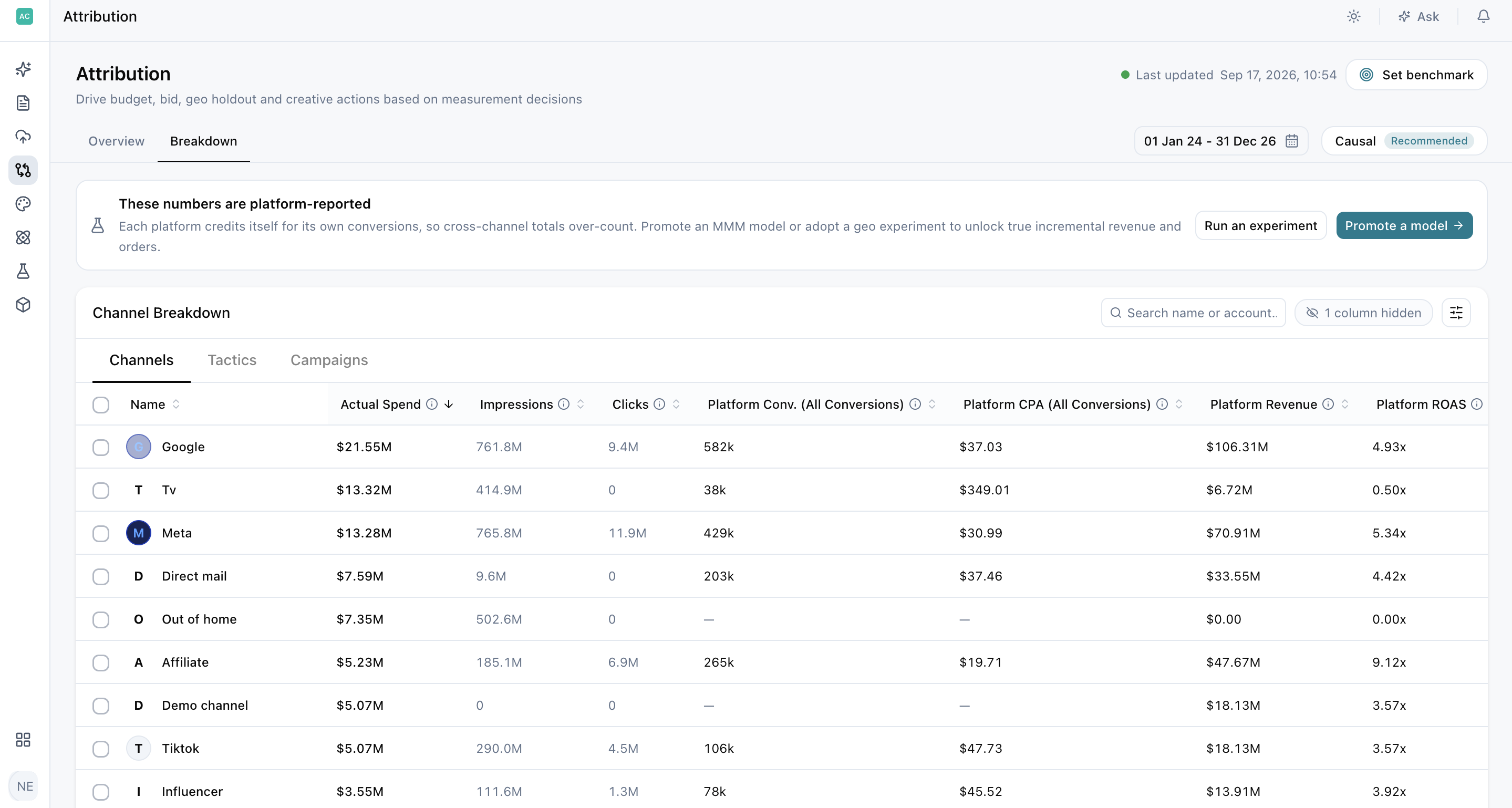
Your active target scenario (the media plan you've selected as your benchmark) sets the goals that pacing and recommendations are measured against. It determines both the benchmark value and the planned spend, so every insight is tied back to what you set out to achieve.
Review what's shaping your results
Select the scenario control to review:
- The metrics being tracked
- The benchmark value
- The analysis periods in use
Note: The more measurement and scenario data your workspace has, the stronger and more reliable your causal recommendations will be. Keeping your Marketing Mix Models promoted, running experiments, and maintaining an active scenario ensures your recommendations reflect how your marketing truly performs.
Frequently Asked Questions
How is Causal Attribution different from touch-based attribution?
Touch-based attribution assigns credit based on clicks and views. Causal Attribution uses evidence from your promoted Marketing Mix Models and experiment results to show what your marketing actually caused.
Where do the incremental results come from?
From your promoted Marketing Mix Models and experiment results.
What is the incrementality factor?
It is the share of platform-reported revenue that is truly incremental. A lower factor means more of a channel's reported revenue would likely have happened anyway.
Why does a channel's incremental revenue differ from its platform-reported revenue?
Platforms report revenue from conversions that followed an ad, including some that would have happened without it. Incremental revenue counts only the additional revenue your marketing created.
How are channels ranked in the Overview?
By incremental value, so the channels contributing the most real growth appear at the top.
Can I see results below the channel level?
Yes. The Breakdown lets you analyze results by tactic, campaign, and ad set, and drill deeper into the entities behind any result.
What does pacing measure?
Pacing compares your spend with the planned spend in your active target scenario, helping you catch overspend and underspend early.
What is an active target scenario?
It is the media plan you've selected as your benchmark. It sets the benchmark value and planned spend that pacing and recommendations are measured against.
What do Scale, Maintain, and Reduce mean?
They are recommendations on where to invest next: increase investment, hold it steady, or pull it back.
Can I act on a recommendation directly?
Yes. You can deploy a recommendation straight into the Decisions workflow.
How can I make my recommendations more accurate?
Keep your Marketing Mix Models promoted, run experiments, and maintain an active scenario. The more measurement and scenario data your workspace has, the more reliable your recommendations will be.
Updated about 3 hours ago