
Create a Geo Experiment
Get a causal answer on performance before you commit more budget
Geo Experiments show you the true incremental impact of your marketing, so you can see which changes actually drive results and invest with confidence.
Platform-reported metrics tell you what happened after someone saw an ad, but not whether the ad caused it. Some of those conversions would have happened anyway. A geo experiment answers the question that matters most: how much additional revenue, conversions, or new customers did this marketing change create?
Geo Testing measures incremental impact by comparing selected test markets with a synthetic control (a benchmark built by combining comparable markets so that it closely mirrors how your test markets would have performed without the change).
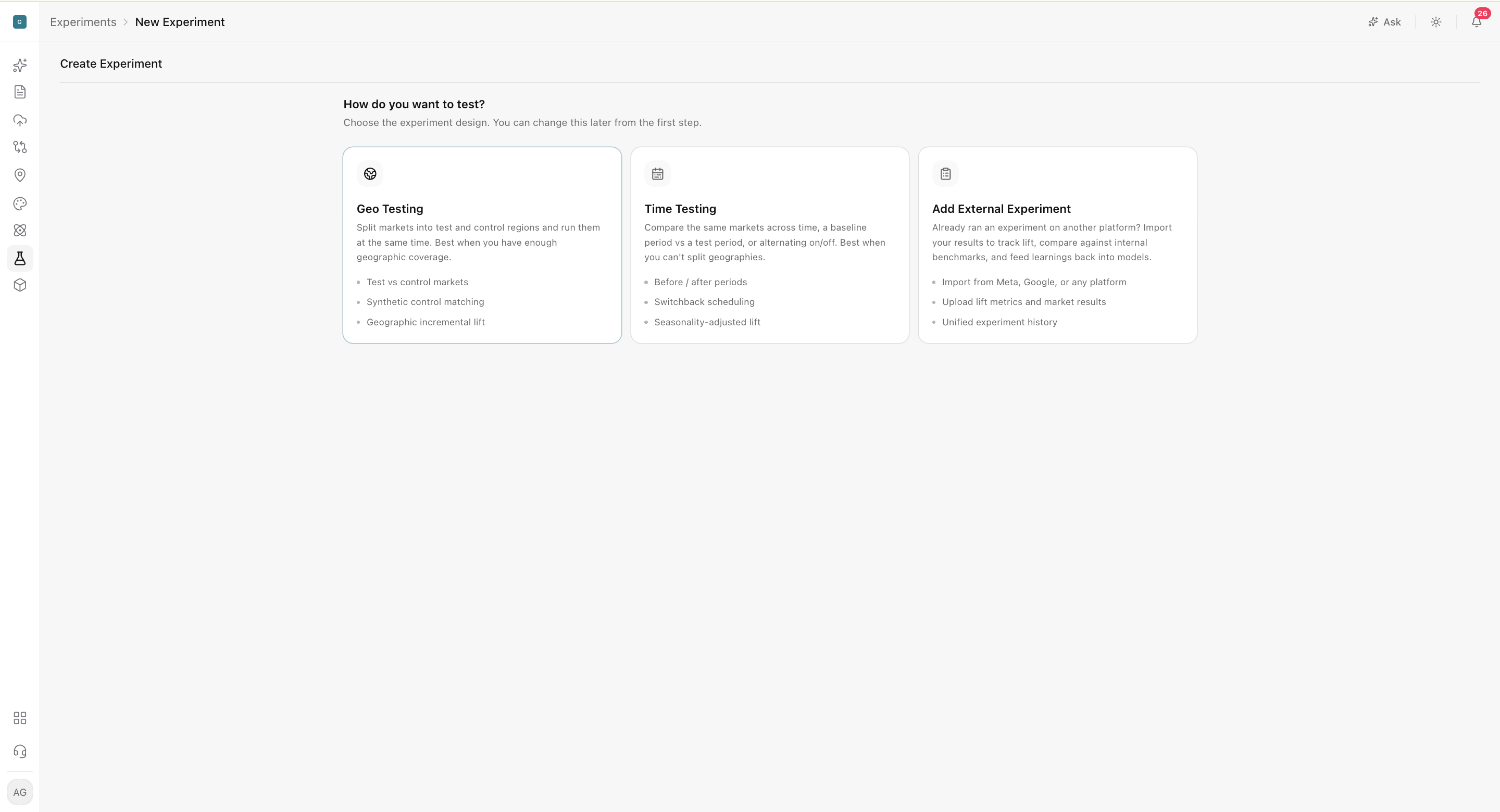
Go from question to proven result
Geo Testing takes you from a business question to a measured answer in seven steps:
- Define the business hypothesis and treatment. Decide what you want to prove, such as "Does our CTV spend drive incremental revenue?", and what change you'll make to test it.
- Upload historical geo-level KPI data. Provide past performance data by market for the outcome you want to measure, such as revenue or orders.
- Configure test cells, duration, markets, and statistical settings. Test cells are the groups of markets that receive a treatment. Your settings determine how long the test runs and how confident the result will be.
- Let Lifesight identify recommended test and control market combinations. Lifesight finds the combinations best suited to produce a reliable result.
- Select markets and campaigns, then schedule the test.
- Monitor progress and calculate lift. Track the test as it runs and measure the difference between test and control markets.
- Review incremental lift, iROAS, confidence, and market results. See how much your change added and how certain the result is.
Choose how to test the change
Treatment options
- Hold-out: pauses or excludes selected activity in test markets. Use it to find out what you'd lose without a channel or campaign, for example, whether your branded search spend is capturing demand that would have come in anyway.
- Scale-up: increases activity in test markets and compares the change with control behavior. Use it to find out whether spending more would drive more results, for example, before committing a larger budget to a new channel.
The available treatment can depend on the selected hypothesis.
Get results you can act on
What a geo experiment provides
- Measured lift: the additional outcome your change created.
- Confidence intervals: the range within which the true result is likely to fall.
- P-value: how likely it is that the result happened by chance. Lower values mean stronger evidence.
- Power: how likely the test is to detect a real effect if one exists.
- iROAS: incremental revenue generated for every dollar spent.
- Treatment-versus-control trends: how test and control markets performed over time.
- Market breakdowns: results for individual markets.
- Recommendations: suggested next steps based on the results.
Where promoted results go next
Use promoted results to support causal Attribution and eligible MMM calibration workflows. This means the lift you prove in a geo experiment can strengthen the accuracy of your other measurement, anchoring attribution and MMM results to real-world outcomes.
Frequently Asked Questions
Why can't I rely on platform-reported metrics?
Platform metrics show what happened after someone saw an ad, not whether the ad caused it. Some of those conversions would have happened anyway. A geo experiment measures only the additional impact your marketing created.
What is a synthetic control?
A synthetic control is a benchmark built from comparable markets. It shows how your test markets would likely have performed without the change, so the difference between the two reflects the true impact.
What data do I need to run a geo experiment?
You need historical geo-level KPI data, meaning past performance by market for the outcome you want to measure.
Do I have to choose test and control markets myself?
No. Lifesight identifies recommended test and control market combinations. You then select the markets and campaigns before scheduling the test.
What is the difference between Hold-out and Scale-up?
Hold-out pauses or excludes activity in test markets to measure what you'd lose without it. Scale-up increases activity in test markets to measure what you'd gain from spending more.
Why is only one treatment available for my test?
The available treatment can depend on the selected hypothesis.
How do I know if my result is reliable?
Review the confidence intervals, p-value, and power together. A narrow confidence interval, a low p-value, and high power indicate a reliable result.
What is iROAS?
iROAS (incremental return on ad spend) is the incremental revenue generated for every dollar spent, based only on the additional impact your marketing created.
Can I use geo experiment results in my MMM?
Yes. Promoted results can support eligible MMM calibration workflows, as well as causal Attribution.
Can I track a test while it's running?
Yes. You can monitor progress and calculate lift during the test.
Updated 30 days ago