
Causal Discovery
Lifesight’s approach to Causal Graph–powered discovery
At Lifesight, the structure of the Causal DAG does not start with an algorithm — it starts with deep domain understanding. This principle is also central to the Pearlian framework: causal structure should be guided by real-world knowledge, not just statistical patterns.
Once this initial structure is defined, Lifesight applies a two-step process:
Step 1: Causal Discovery
Step 2: Causal Effect Estimation
[Note : ML Based inference, which is the second pillar of MMM framework runs parallel to the Step 1. The Direct effects estimated in this step is then back-propagated using causal adjustment multiplier from Step 2 ]
Statistical Paradoxes and the Intuition behind the need for Causal Graph
Before diving into thee steps of Causal Discovery & Estimation , it is essential to build the right intuition about why causal structure matters in the first place. The fastest way to build this intuition is by understanding two classic causal errors that regularly mislead marketers, analysts, and even advanced models:
- Simpson’s Paradox
- Berkson’s Paradox
These paradoxes demonstrate how incorrect conditioning or aggregation can completely reverse or fabricate relationships between variables.
Causal Intuition: Simpson’s Paradox vs Berkson’s Paradox
These two paradoxes explain why naïve regression or correlation analysis fails - and why causal graphs are necessary.
Simpson’s Paradox – The Hidden Confounder Problem
Reference 1 - https://brilliant.org/wiki/simpsons-paradox/
Reference 2 - https://en.wikipedia.org/wiki/Simpson%27s_paradox
Simpson's paradox is a phenomenon in probability and statistics in which a trend appears in several groups of data but disappears or reverses when the groups are combined.
Most errors in marketing measurement are not due to weak algorithms, but due to incorrect causal assumptions.
Structure:
A hidden variable (Z) influences both X and Y
Fast Causal Inference (FCI) Algorithm
Below mentioned is a broad skeleton of Causal Graph (In the actual causal graph, each of these nodes will be exploded to its specific)
Example : Brand Tactics will be expanded to TV, OOH, Prospecting Tactics across Meta, Google Display, Youtube, TikTok etc... Performance Tactics will be expanded to Search, Retargetting etc...
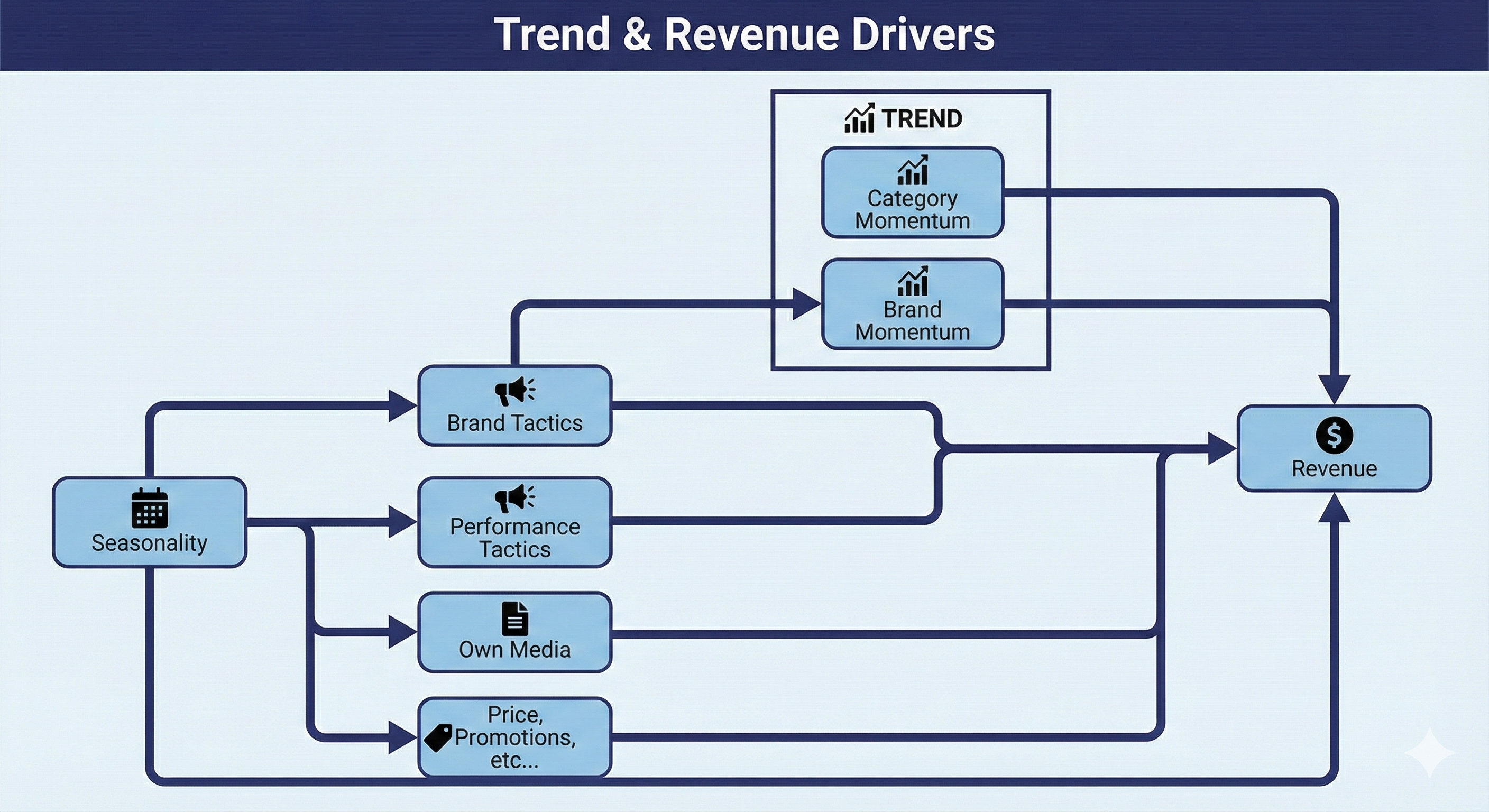
We then apply the approach know as Fast Causal Inference , which is a very popular variant of PC algorithm, but unlike PC algorithm Fast Causal Inference assumes unobserved variables in the DAG.
FCI = PC + Real-World Awareness
| Phase | PC algorithm | FCI algorithm |
|---|---|---|
| Skeleton | Uses conditional independence tests to remove edges | Same as PC but more conservative |
| Separating sets | Stores sepset(A, B) | Same but used later more aggressively |
| Collider detection | Identifies A → B ← C | Same but with extra latent checks |
| Orientation | Uses Meek’s orientation rules | Uses extended orientation rules for latent confounders |
| Extra search | — | ✅ Performs additional conditional tests on subsets (Possible D-SEP) |
| Output | CPDAG | PAG |
FCI = PC + extra conditional tests + conservative orientation
FCI Methodology
| Phase | Step | What happens (Methodology) | Key Output | What this gives you in MMM / Lifesight |
|---|---|---|---|---|
| 1. Problem setup | 1.1 Define variables | Select observed variables (media, revenue, price, seasonality, events, etc.) | Variable set V | Ensures all measurable drivers are accounted |
| 1.2 Draw prior DAG | Create expert-driven initial DAG (allow partially directed edges) | Prior DAG | Encodes business knowledge & causal beliefs | |
| 1.3 Define constraints | Lock impossible edges (e.g., Revenue → Spend) | Constraint matrix | Prevents nonsensical directions | |
| 2. Data prep | 2.1 Time alignment | Align all variables to same granularity & lags | Clean dataset | Prevents spurious causal detection |
| 2.2 Normalization | Scale / transform variables (log, z-score, adstock) | Model-ready data | Improves CI test reliability | |
| 2.3 Stationarity checks | Test for drift / non-stationarity (ADF, KPSS) | Stationary series | Required for accurate inference | |
| 3. Skeleton discovery | 3.1 Fully connected graph | Start with complete undirected graph | G₀ | No assumptions removed yet |
| 3.2 Cond. independence tests | Remove edges A–B if A ⫫ B | S | Skeleton graph + Sepsets | |
| 4. Possible-D-SEP expansion | 4.1 Compute Possible-D-SEP | Find nodes that could d-separate A and B with hidden confounders | Expanded conditioning sets | Simulates invisible variables |
| 4.2 Extra CI tests | Retest adjacencies with PDS | Revised skeleton | Removes false edges missed by PC | |
| 5. Orientation (colliders) | 5.1 Find v-structures | If A and C not in Sepset with B → mark A → B ← C | Initial directions | Detects mediators |
| 5.2 Check against PDS | Revalidate with latent-aware logic | Refined v-structures | Avoids false collider claims | |
| 6. Orientation (rules) | 6.1 Apply extended Meek rules | Orient where logically forced | Directed edges | Prevents cycles |
| 6.2 Partial orientation | Use ambiguous tails (o→, o-o) | PAG graph | Encodes uncertainty explicitly | |
| 7. Selection bias handling | 7.1 Detect S-bias | Identify possible selection variables | S-flagged edges | Explains biased correlations |
| 8. Causal strength estimation | 8.1 Identify identifiable edges | Keep only directed / semi-directed paths | Estimable subgraph | Safe-to-quantify relationships |
| 8.2 Choose estimator | Regression / SEM / SCM / DoWhy / PyMC | Estimation engine | Translates structure → effect | |
| 8.3 Estimate total effect | Compute ATE / direct / indirect effects | Effect size | “Spend → Revenue” impact | |
| 8.4 Estimate uncertainty | Bootstrap / MCMC / Bayesian HDI | Confidence / Credible intervals | Model reliability | |
| 9. Strength scoring | 9.1 Edge stability | Run FCI across subsamples | Stability % | Robustness metric |
| 9.2 Orientation confidence | % of times same arrow appears | Direction probability | Trust in direction | |
| 9.3 CI test strength | p-value or partial corr | Dependency strength | Relationship reliability | |
| 9.4 Composite causal score | Weighted score: (stability + direction + p) | 0–1 causal strength index | Rank channels by causal validity | |
| 10. Validation & interpretation | 10.1 Compare to experiments | Check aligned with lift tests / geo tests | Coherence score | Ground truth alignment |
| 10.2 Causal vs predictive gap | Compare vs MMM regression | Divergence measure | Identify overfitting or bias | |
| 10.3 Final decision | Flag strong vs weak assumptions | Causal readiness index | Deployment readiness |
Example of the Output
| Relationship | PAG edge | Stability | Direction confidence | Avg p-value | Causal Strength Score |
|---|---|---|---|---|---|
| Meta → Revenue | → | 0.91 | 0.89 | 0.002 | 0.90 (Strong) |
| TV ↔ Revenue | ↔ | 0.63 | 0.10 | 0.04 | 0.41 (Weak) |
| Search → Revenue | → | 0.95 | 0.93 | 0.001 | 0.94 (Very strong) |
| Influencer o→ Search | o→ | 0.55 | 0.45 | 0.07 | 0.50 (Weak) |
| Email → Revenue | → | 0.88 | 0.90 | 0.01 | 0.89 (Strong) |
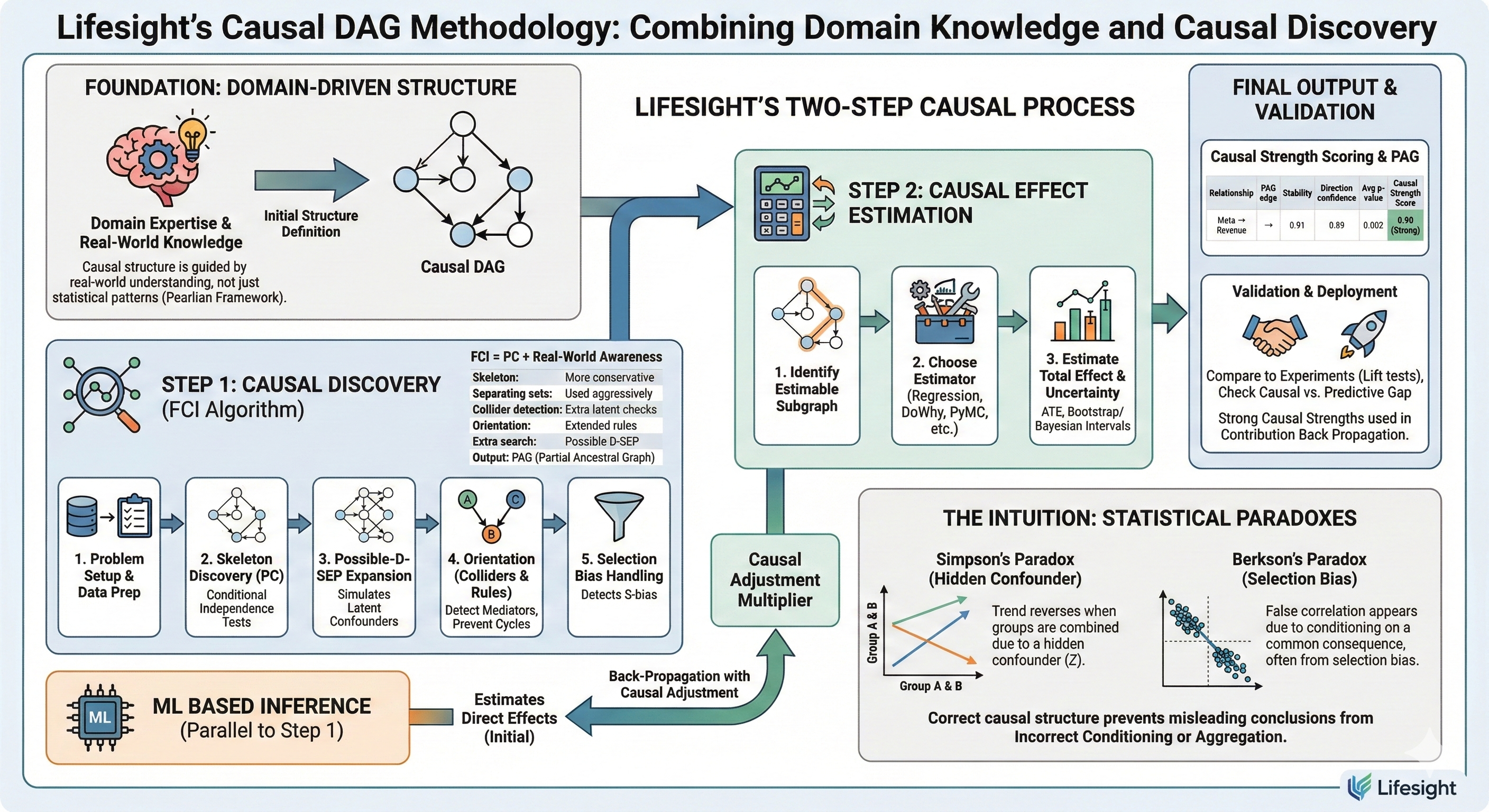
Strong causal strengths are then used in the Contribution Back Propagation approach as mentioned here
Updated 9 months ago