
Lifesight's Modeling Framework
Lifesight's approach to robust causal inference and accurate prediction
Lifesight's Modeling Principles
Lifesight’s approach to Marketing Mix Modeling is guided by three core principles : Transparency, Causality, and Algorithmic Fit. Together, these principles define how we design, build, and operationalize models that marketers can both trust and act upon.
- Transparency
We believe that measurement should be a glass box, not a black box. Lifesight has built an end-to-end modeling platform that allows users to directly upload, transform, map, configure, and train models under different assumptions - including custom causal DAGs, and flexible "weakly informative" priors for adstock and saturation. Every step of the modeling process is transparent and reproducible, giving users full control over how data flows, variables interact, and results are derived.
- Causality
Traditional MMM approaches often rely on post-hoc calibration using results from marketing experiments to make the model causally sound. While Lifesight fully supports and endorses experiment-based calibration of models, we go a step further by embedding Causal AI techniques directly into our model-building process. This ensures that causal reasoning is not an afterthought but a core property of the model itself, improving both interpretability and robustness.
- Algorithmic Fit
Right Algorithm for the Right Task ! We use a hybrid modeling framework that combines the strengths of Structural Causal Modeling, Machine Learning–based Inference, and Ensemble Forecasting. This “best-fit” approach ensures that each stage of the MMM workflow - from variable selection to prediction - leverages the right algorithm for the right purpose, balancing interpretability, precision, and scalability.
This is a unique approach in the industry where the debate is often limited to just Frequentist Vs Bayesian approaches to MMM, Or Pearlian Vs Rubin approaches to Causal Inference.
The Three Pillars of Lifesight's MMM Framework
Lifesight’s modeling framework blends three complementary techniques to deliver robust, interpretable, and scalable MMM results. Each component serves a specific purpose in ensuring that the models capture real-world marketing dynamics accurately.
- Structural Causal Modeling (SCM)
We begin our modeling process by encoding the cause-and-effect relationships between input factors into a Causal Directed Acyclic Graph (DAG). This graph represents the data-generating process of your business - independent of the actual data distributions. Think of it as a digital clone of your marketing and business system. This structure allows us to map out and isolate mediation effects that are otherwise hidden in traditional regression-based approaches.
For example: Top-of-funnel campaigns influencing branded search performance, Prospecting ads driving more retargeting exposure, Brand-building campaigns strengthening the baseline demand
Once the DAG is defined, Lifesight’s platform quantifies the strength of each causal link within it, estimating the magnitude and direction of influence between variables. These DAG structures are fully configurable by the user, making them a critical and transparent step in the model-building process at Lifesight.
[ Find more about this here ]
Note - Structural Causal Models precede the actual models. This is primarily informed by your deep intuition about the business and how data is actually generated. Though our casual discovery process will then score the strength of these assumed relationship - DAG is primarily the product of business domain knowledge and human judgement.
- Machine Learning–based Inference
Once the causal structure is defined and validated, Lifesight applies machine learning–based inference techniques to estimate the direct effects of all variables on the business outcome. The process begins with a ridge regression–based model, which helps capture stable relationships across multiple predictors while avoiding overfitting. Each variable is first transformed using the appropriate adstock (carryover) and saturation (diminishing returns) functions to reflect real-world, non-linear marketing dynamics. The model is then trained and iterated through thousands of runs to ensure convergence and robustness. This results in a large number of solutions—often more than 100,000 model variants—each representing a different but plausible version of the data-generating process.
From these solutions, Lifesight selects the best-fitting models and applies a bootstrapping approach to estimate the average effects and confidence intervals for each variable. This process ensures both accuracy and stability of the results.
Finally, using the validated DAG as a guide, Lifesight runs nested regression models to quantify the indirect (mediated) effects of variables - for example, when upper-funnel campaigns influence lower-funnel conversions. By combining both direct and indirect effects, and by applying a backpropagation algorithm in reverse topological order, the model redistributes direct effects across indirect edges and computes the true total effect of every variable. In doing so, it estimates the total causal impact of every marketing and non-marketing driver.
[Find more about this here ]
- Ensemble Forecasting
Forecasting in marketing is inherently time-series–driven, relying on the auto-regressive nature of business data : where today’s outcomes are influenced by yesterday’s results. Traditional regression techniques, however, assume data points are independent and identically distributed (IID), which limits their ability to fully capture these temporal patterns. These limitations are addressed in MMM by introducing time-varying components into the baseline. However, this limits model's true ability to make accurate long term forecasts. To address this, Lifesight employs an ensemble of advanced forecasting algorithms - including SARIMAX, ARIMA, Bayesian, and LSTM models. These algorithms are trained on the most recent two years of historical data, incorporating all known covariates (such as marketing, pricing, and macroeconomic variables). The core question they answer is: “What would happen to your business next year if you continued operating exactly as you did last year?” On top of this baseline forecast, Lifesight applies what we call Incrementality Adjustments to Ensemble Forecasting. Here, the machine-learning based model (which has already inferred adstock, saturation, incremental effects and interaction effects) provides causal adjustments to the pure time-series forecast. The result is a projection that reflects both statistical continuity and causal understanding — not just what will happen, but why.
[Find more about this here ]
By combining Structural Causal Modeling + Machine Learning based Inference + Ensemble Forecasting, Lifesight achieves the best possible algorithmic fit for tackling marketing measurement, optimization, and forecasting challenges - while maintaining causal interpretability throughout the process.
Lifesight's Modeling Framework
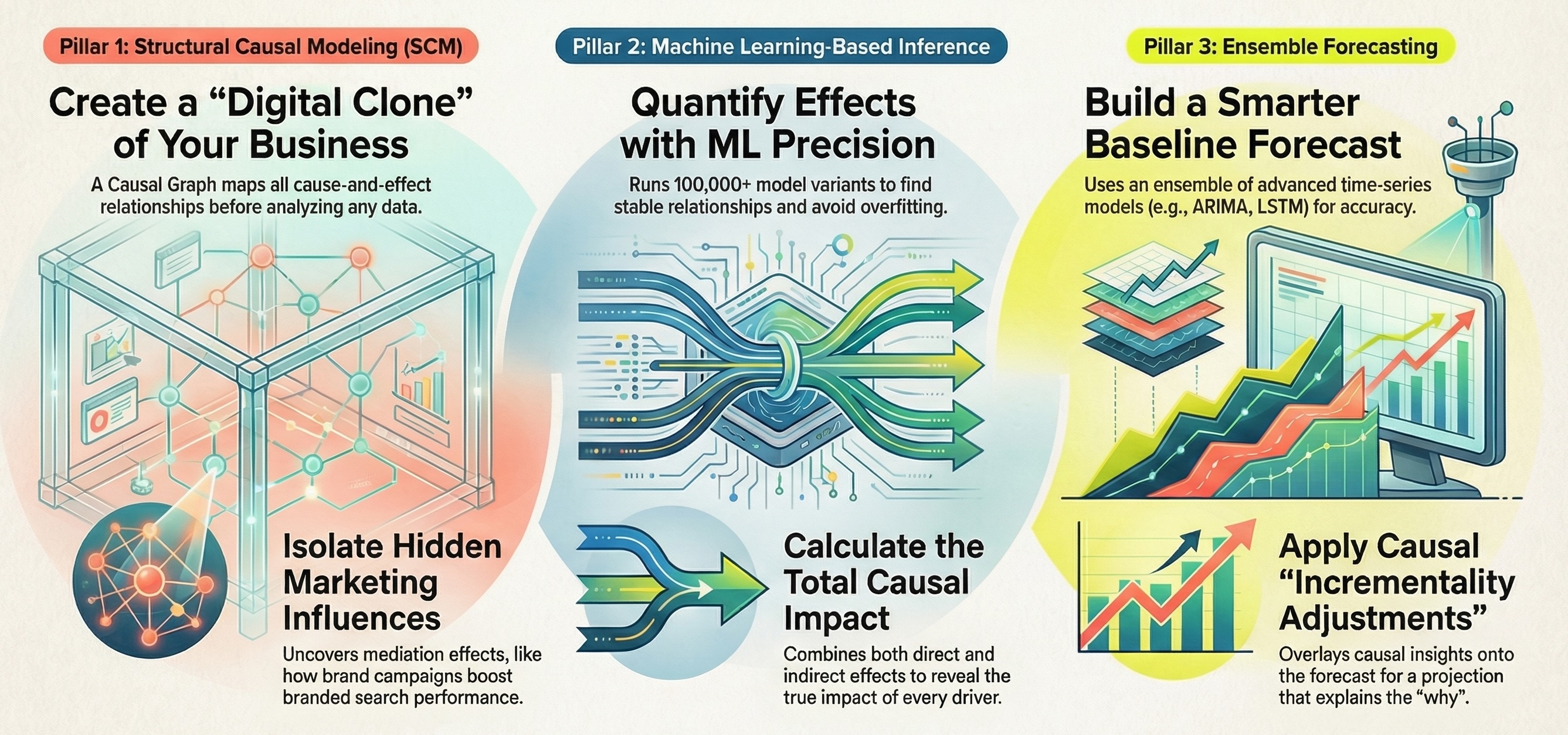
Next we will dive into each of these pillars of Lifesight's MMM framework, starting with the why and the how of Causal Reasoning in Modeling
Updated 3 months ago