
Evolutionary Fine Tuning
How Lifesight Uses Evolutionary Algorithms to Build Your Ideal Model
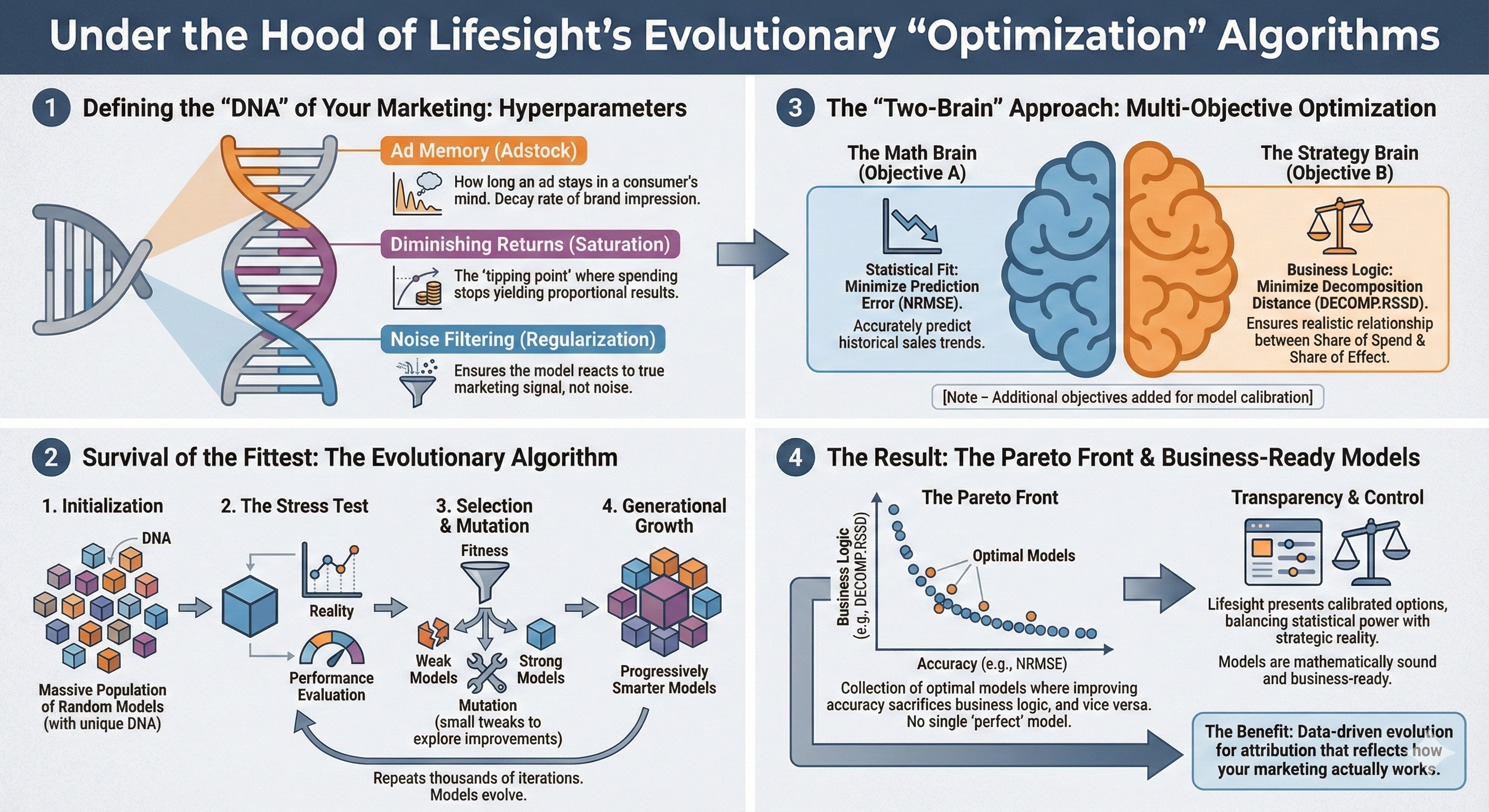
Under the hood of Evolutionary "Optimization" Algorithms
Building a Marketing Mix Model (MMM) used to be a manual process of trial and error. An analyst would tweak variables, run a regression, check the error, and repeat - often introducing human bias along the way. At Lifesight, we take a different approach. We treat model selection not as a math problem to be solved once, but as an evolutionary process. Our engine generates thousands of potential models, tests them against reality, and uses Evolutionary Algorithms to "breed" the most accurate and logical outcomes.
In the previous pages we learned about adstock transformation and saturation transformation. These transformation are applied by running the data through different transformation functions (Geometric Decay / Weibullf PDF for Adstock & Hill Function for Saturation). These functions have a few hyper parameter values that needs to be arrived at, so that optimize for a target objective - say lower estimation error, or lower nrmse. Finding this right set of hyper parameter values is a massive optimization process based on principles of Evolutionary Algorithm.
Here is how our engine finds the right hyper-parameters for your specific data.
- Defining the "DNA" of Your Marketing
Every business is unique. To capture this, our model optimizes a specific set of Hyperparameters - think of these as the DNA of the model. We don't just look at spend; we look at the behavior of that spend:
Ad Memory (Adstock): How long does an ad stay in a consumer's mind? Does a brand impression decay in two days or two weeks?
Diminishing Returns (Saturation): At what point does spending more money stop yielding proportional results? We look for the "tipping point" for every channel.
Noise Filtering (Regularization): How do we ensure the model reacts to true signal (marketing impact) rather than random noise in the data?
- Survival of the Fittest: The Evolutionary Algorithm
Instead of trying to guess these parameters, the Lifesight engine uses Evolutionary Algorithms. The process mimics natural selection:
Initialization: The engine creates a massive population of random models, each with different "DNA" (combinations of adstock, saturation, and coefficients).
The Stress Test: Each model is evaluated to see how well it performs.
Selection & Mutation: The "weak" models (those that don't fit the data or don't make sense) are discarded. The "strong" models are kept and "mutated"—slightly tweaked to explore if small changes improve performance.
Generational Growth: This cycle repeats for thousands of iterations. Over time, the models evolve, becoming progressively smarter and more accurate.
- The "Two-Brain" Approach: Multi-Objective Optimization
Most traditional modeling tools optimize for a single metric: Accuracy (low prediction error).
The problem? A model can be mathematically accurate but strategically impossible. For example, a model might predict sales perfectly but claim that TV contributes $0 revenue despite $1M in spend. This is "overfitting."
Lifesight uses Multi-Objective Optimization to solve for two conflicting goals simultaneously:
Objective A: Statistical Fit (The Math Brain): We minimize the prediction error (NRMSE). The model must accurately predict historical sales trends.
Objective B: Business Logic (The Strategy Brain): We minimize "Decomposition Distance" (DECOMP.RSSD). This metric ensures that the relationship between Share of Spend and Share of Effect is realistic. It penalizes models that suggest a channel with high spend has near-zero impact (or vice versa) without strong evidence.
[Note - Additional objectives are added when it comes to model calibration]
- The Result: The Pareto Front
Because we optimize for two conflicting objectives (Math vs. Logic), there is rarely a single "perfect" model. Instead, our engine delivers a Pareto Front.
The Pareto Front is a collection of the optimal models where you cannot improve accuracy without sacrificing some business logic, and vice versa.
The Benefit: This gives you transparency and control. Rather than forcing a single "black box" number on you, Lifesight presents the best possible options—calibrated to your specific business context—allowing us to select the model that balances statistical power with strategic reality.
Lifesight’s modeling engine moves beyond simple regression. By utilizing Evolutionary Algorithms and Multi-Objective Optimization, we ensure that your model isn't just mathematically sound—it’s business-ready. We let the data evolve the solution, resulting in attribution that reflects how your marketing actually works.
Model Convergence
In the dynamic world of marketing mix modeling, determining when a model has reached convergence is crucial for ensuring reliable results. At Lifesight, we employ specific criteria to assess model convergence, enabling us to provide accurate insights to our clients.
What is Model Convergence?
Model convergence refers to the point at which further iterations of the optimization process no longer yield significant improvements in the model's performance. In essence, it's when the model has discovered a stable solution that best fits the data.
Lifesight's Convergence Criteria
At Lifesight, we utilize two primary criteria to determine if a model has converged:
1️⃣ Criterion 1: Standard Deviation Stability
We compare the standard deviation of the last quantile to the mean standard deviation of the first three quantiles. The model is considered to be converging when:
This criterion ensures that the variability in the model's performance has decreased and stabilized over the course of the optimization process.
2️⃣ Criterion 2: Absolute Performance Threshold
We assess the overall improvement in performance by comparing the last quantile to the first quantile. The model is considered to be converging when:
Last quantile's absolute median< Absolute first quantile's absolute median - 2 * First 3 quantiles' mean standard deviation
This criterion ensures that the model's performance has significantly improved from its initial state, reaching a predefined threshold of excellence.
Understanding Quantiles
In our methodology, we divide the total number of model iterations into quantiles:
- At Lifesight we run 5000 iterations for each model, so each quantile represents 1250 iterations
- First quantile: iterations 1-1250
- Second quantile: iterations 1251-2500
- And so on...
This division allows us to track the model's progress and performance over time, providing a clear picture of its convergence path.
Key Performance Metrics
We focus on two crucial performance metrics:
-
NRMSE (Normalized Root Mean Square Error)
- Measures the model's overall error
- Crucial for assessing model quality
- Lower values indicate better model fit
-
CIDI (Channel Impact Divergence Index)
- Quantifies the allocation of effects between different marketing channels
- Indicates how "radical" the model's recommendations are
- Lower values suggest more balanced channel impact predictions
Interpreting Convergence Results
- Both criteria must be satisfied for full model convergence
- Greater emphasis on NRMSE convergence (direct reflection of model accuracy)
- CIDI convergence interpreted cautiously:
- Low CIDI ≠ Necessarily better model
- Low CIDI = Less extreme recommendations for spend and effect allocation
- Continuous monitoring: Convergence is an ongoing process, not a fixed endpoint
Example Scenario
Consider a 50/50 investment split between channels A and B:
| Model | Channel A Effect | Channel B Effect | CIDI | Interpretation |
|---|---|---|---|---|
| 1 | 100% | 0% | High | Extreme allocation, potentially overfit |
| 2 | 50% | 50% | Low | Balanced allocation, potentially underfit |
| 3 | 70% | 30% | Medium | Moderate allocation, potential optimal fit |
Next let us learn about how we sample the right solutions from all the solutions generated from the model tuning step. Find out more about this here
Updated 9 months ago