
What is Unified Marketing Measurement
Why measurement takes a system, not a single tool.
Unified Marketing Measurement (UMM) helps you see what your marketing truly drives. It runs Marketing Mix Modeling, Incrementality Testing, and Causal Attribution together as one system, on one data foundation, so each method strengthens the others.
No single model or number can settle what your marketing is worth. The problem has no one exact answer, only a range of likely ones. A method that claims to remove that uncertainty is hiding it.
UMM takes the opposite view. It combines several imperfect reads, each with a different blind spot, so they keep each other honest.
The problem with one method
Each method answers one question
Every method is useful. Each one breaks down when it is asked to answer everything.
Attribution follows the customer. But knowing a customer touched an ad does not tell you if they would have bought anyway. It answers "who gets credit?" not "what caused the sale?"
Marketing Mix Modeling sees the whole business, including price, promotions, and seasonality. But it runs on thin, aggregated data. Where the signal runs out, it leans on modeling choices you rarely see.
Incrementality Testing is the most rigorous. It measures real lift from a controlled test. But markets keep moving, and tests end before carryover effects do. The result is one point in time.
None of these methods is wrong. Each is a partial answer that gets sold as a complete one.
The most expensive mistake in measurement is believing that one method is enough.
Decisions happen at three levels
Before you pick a method, ask what decision it needs to support. A method that works well for one level can be useless for another.
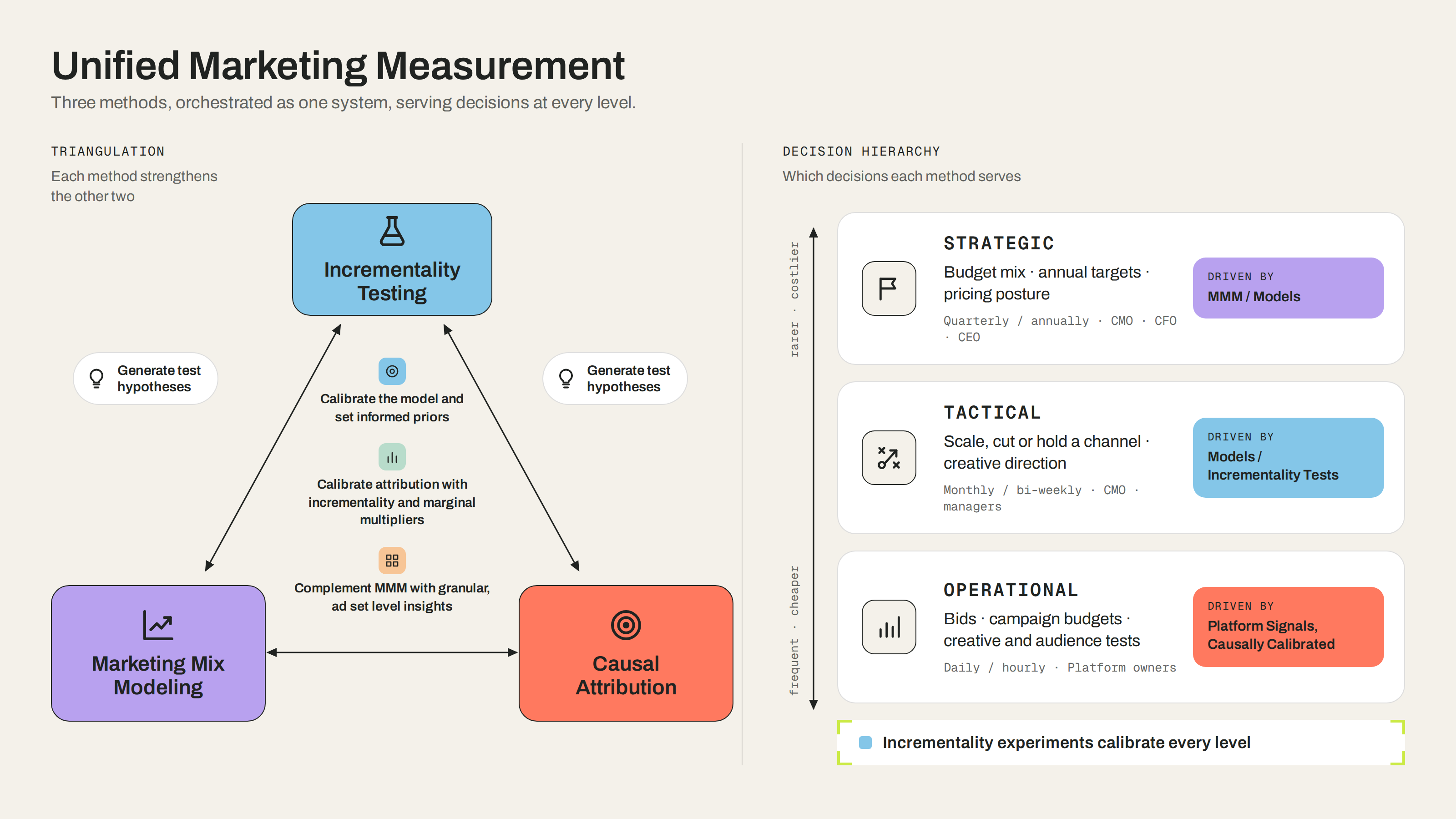
| Level | Decisions | Cadence | Owner | Best served by |
|---|---|---|---|---|
| Strategic | Budget mix, annual targets, profitability goals, pricing, big bets | Quarterly / annually | CMO, CFO, CEO | Marketing Mix Modeling, the only method that sees the whole picture and can forecast |
| Tactical | Scale, cut, or hold a channel; creative direction; prospecting vs. retention | Monthly / bi-weekly | CMO, marketing managers | MMM outputs turned into allocation (incrementality and marginal returns) |
| Operational | Campaign budgets, bids, creative and audience tests, pacing | Daily / hourly | Platform owners | Causal Attribution for detail, anchored by Incrementality Testing |
These are different decisions on different clocks. One tool cannot serve all three.
How UMM solves it
Measure incrementality, not credit
The question that matters is simple: what would have happened if the marketing had not run?
Incrementality is the outcome with marketing minus the outcome without it. It counts only the sales that exist because of the marketing.
Attribution never answers this. It splits credit within what already happened. That is why a channel can show a strong attributed return and add almost nothing.
Example: branded search. A customer who already plans to buy searches your brand name, clicks your ad, and converts. Last-click attribution credits the ad. But the ad only caught a sale that was already coming. Optimize to this number and you over-invest in demand you would have won anyway.
Each method estimates that "without marketing" outcome in its own way:
- Experiments build it from a control group.
- MMM builds it statistically, by predicting results at zero spend.
- Attribution cannot build it alone, which is why it needs the other two.
Expect the methods to disagree
A new experiment says a channel returns 1.9x. The MMM says 2.9x. Teams often assume one of them is broken.
Neither is. The MMM reports an average over the full modeling window, like a road trip that averaged 50 mph. The experiment reports one moment on that same curve: how the channel performs today.
An experiment and an MMM measure the same channel at different time scales. Disagreement is expected. The skill is reading each one for what it is.
That shift, from "our models contradict each other" to "our models describe the business at different time scales," is where UMM starts.
Connect the methods into one system
Triangulation is often read as "line up three numbers and check they match." They will not match, and you could do that in a spreadsheet.
The real value comes from connecting the methods so each one improves the others:
- Experiments are the closest thing to causal truth. Their results calibrate both MMM and Attribution.
- MMM sees the whole picture. It shows which channels are worth testing next and removes double-counting from attribution.
- Causal Attribution adds ad set and creative level detail. Its sudden swings point to new hypotheses to test.
We call this measurement orchestration. It only works on one shared data foundation. An experiment can calibrate an MMM only if its result flows into the next model refresh. MMM can remove double-counting only if both run on the same events.
Stitch three separate vendors together and you are back to the spreadsheet: three numbers, no connections.
Triangulation is the principle. Orchestration is the practice. It is the difference between owning three tools and running one system.
Updated about 2 hours ago